
When it comes to Education and Technology, “Efficiency” is not the point

One of my goals (one of many, far too many, goals) during the sabbatical is to post more here– probably still mostly about higher ed and MOOCs, but hopefully other stuff too. I think it would be a good idea to shift back away from Facebook and Twitter. Don’t ask me why I think that’s a good idea right now; it just seems like it is.

This seems a good place to start: from U.S. News and World Report (which I think is just a web site nowadays) comes “Professors Grow Weary of Idea That Technology Can Save Higher Ed,” with the subheadline “Some say bringing high technology to higher ed makes it less, not more, efficient.”  As a slight tangent: the author of this article is something called “The Hechinger Report,” which “is an independent nonprofit, nonpartisan organization based at Teachers College, Columbia University” that apparently generates a lot of articles about education that get poured right into a lot of mainstream publications.

Anyway, a quote:

Universities and colleges are marketing themselves to tech-savvy teenagers while promising higher productivity and financial savings. They will pour $10.4 billion into education technology this year, according to the Center for Digital Education, from computers to in-class gadgets such as digital projectors and wireless “clickers” that let students answer questions electronically.

But professors say they don’t have enough help to use this technology effectively, haven’t seen results from it, and fear that the cost savings administrators keep insisting that technology will bring could mean their own careers are on the line.

The assumed purpose of technology (e.g., computer stuff, basically) in this article is efficiency, and some version of that word/theme appears at least a dozen times in this 1,000 or word so piece. And– surprise, surprise!– it turns out that computer stuff doesn’t make education more efficient.

First off, duh.

Second, (to expand a bit on that first point), one of the main problems I always have with these kinds of articles is the assumed definition of technology. Instead of defining technology as any sort of tool like pens or paper or chalkboards or even literacy itself (Ong), technology is “anything that doesn’t seem normal to us, particularly computers stuff:” that is, “clickers,” “gadgets,” “digital projectors,” etc. Things that were recently “technology” often become quickly naturalized so they no longer qualify as “gadget” or “new-fangled”– email and cell phones, for example. Maybe it’s unfair of me to expect any definition of technology to be any more nuanced than that, but it’s still frustrating.

Third, (also expanding on my “duh”), efficiency is not the point. Modern computer technologies allow teachers and students to do things differently now than they did things five or ten or twenty or however many years ago, but that doesn’t necessarily (or even usually) make things more efficient. Take online courses in the broadest sense. Anyone who has taught or taken an online class knows that the advantage of the technology is it alters the time and space of a traditional “classroom:” you can be in class from wherever you can get a decent internet connection and you can engage in the class on your own schedule (more or less, and assuming the class is asynchronous). But online courses are a fairly inefficient way to convey information and to interact with each other. In a face to face class, we can all discuss a reading or an assignment in one time and place; in an online class, not so much. Often, this inefficiency shifts to the instructor– that is, it takes a lot more time to teach an online class than it does to teach a face to face one– and that’s one of the reasons why a lot of faculty have no interest in teaching online.

This ongoing quest for efficiency and cost savings (generally by employing fewer teachers and/or by having bigger classes) drives MOOCs and other online experiments, just as it was the motivation behind correspondence schools in the late 19th/early 20th centuries and the first wave of online courses a decade or so ago. For students (and parents of students), seeking efficiency makes sense. Over Christmas at my parents in Iowa, the conversation with the brothers-in-laws turned to the cost of higher education (one of them is preparing to send a kid to college next year), and this desire for efficiency came up. It wasn’t the right place or time to explain what I see as the actual reasons for the costs of higher ed (administrative costs, assessment, athletics, student amenities, and a sharp decline in state subsidies), but I did try to point out that education is an inherently inefficient enterprise, sort of like a string quartet (e.g., Baumol’s cost disease).  Education generally– teaching in particular– doesn’t scale the same way that content does. Efficiency is not the point.

I’m not sure I was very persuasive, and as a parent who is also looking down the barrel of paying tuition for our son next year, I share a lot of my brother-my-law’s feelings on this.
Ungrouping Groups, pros and cons (and other reflections on Fall 2014 teaching)

Normally at this time of year, during the holidaze on some family visit (now at the inlaws and later at my side of the family), I’m finishing the planning for the next semester’s classes and reflecting a bit on the semester that has just been. But since I’ll be sabbaticalling in winter term, now I’m just reflecting, and in particular not assigning a collaborative project in either of my classes.

(This is mostly interesting to me and for “future Steve” to read when he actually has to start thinking about the fall 2015 term. But just in case anyone else is interested, I thought I’d put it all here).

Continue reading “Ungrouping Groups, pros and cons (and other reflections on Fall 2014 teaching)”

“MOOCs” by Jonathan Haber: a review and more sabbatical anxiety

The main anxiety I have about my sabbatical project on MOOCs is the quickly approaching irrelevance of this work thanks to the passing of time and already published/in the pipeline books. I could see this working against me in two different and competing ways.

The first is that the quick rise and fall of MOOCs might mean that the “window of opportunity” to get a book-length manuscript published is closing quickly. I’m glad Charlie Lowe and I were able to strike when we were able to strike with Invasion of the MOOCs, but now I worry that it’s simply too late for another MOOC book.

At the same time, I’m worried that too many others have leapt out in front of me in the rush to publish on MOOCs. There are already about a dozen legitimate, academic or quasi-academic books out there on MOOCs (though a lot of what I’ve read has been pretty superficial and more in the vein of “how to succeed in MOOCs” rather than anything approaching critique or analysis.) I know at least one (maybe two or three?) other people in my field who are on sabbaticals now or soon and who said they were going to be working on MOOC projects of their own, amazon.com is already listing just shy of a half-dozen academic-ish books with “MOOC” in the titles that will be published in 2015, and I know of at least one other edited collection on the horizon about MOOCs. So by the time I have something to share with a publisher in August 2015 or so, the publisher is liable to say “that’s so 2014.”

(But I have to acknowledge that I am over-dramatizing this anxiety right now; the fact of the matter is I won’t get my sabbatical revoked if this project doesn’t pan out, I might end up shifting direction with my sabbatical anyway, etc., etc.).

So this is what has been on my mind as I was reading MOOCs by Jonathan Haber.


Continue reading ““MOOCs” by Jonathan Haber: a review and more sabbatical anxiety”

My iPad and “killer apps” for academics, almost four years later

I was checking out some of the statistics on hits and such to this site a week or so ago, and one thing that surprised me is that the most popular “all time” post I have on the site (at least since the WordPress plugin Jetpack started keeping track of things) is not about MOOCs, academic life, teaching, cooking, etc. Rather, the most popular single post on this site is “iPad “killer apps” for Academics (maybe),” which I posted on April 10, 2010.

Of course, it’s also important to point out out that no post on this site is really all that popular. I average about 50 or so views a day, sometimes up to 100 when I post something that people find interesting. The most views this site ever received in a single day was 737, and even this most popular of posts on iPads has only received (as of this writing) “all time” 4,794 views. Sure, that’s more people than have ever attended all of the conference presentations I’ve ever given and it’s probably more “views” than any print piece of scholarship I’ve published. But these are still not exactly the kind of traffic numbers that are going to allow me to quit the day job and just blog full-time.

(Oh, and as another thought/tangent: the archives for this site goes back eleven years now. I’ve slowed down quite a bit, but damn, that’s a lot of blogging. Another sabbatical project might involve going back to read through all that and/or “mine” it a bit for text/writing I can repurpose.)

Anyway, a few years later and after I bought my first iPad, what do I think now of what I said then?

Continue reading “My iPad and “killer apps” for academics, almost four years later”

“MOOCs as Liberators, MOOCs as Colonizers: A Dilemma” (my Cultural Rhetorics Conference Presentation)

Here is the text (more or less) and the slides for a presentation I’m giving on Friday as part of  the Cultural Rhetorics conference at Michigan State University, which is running on October 31 and November 1. I’m happy to be doing this because I want to support this first time conference and because it’s very local and on very friendly territory for me. The only bad thing is I’m presenting at the last session on the Friday of the conference (which is also Halloween!), so I’m not exactly expecting a standing room only kind of crowd. But we’ll see what happens. Anyway, I am making this post live just before my talk on Friday is underway. I am guessing I’ll have more to post about the conference a bit later.

Continue reading ““MOOCs as Liberators, MOOCs as Colonizers: A Dilemma” (my Cultural Rhetorics Conference Presentation)”

A blog post that will substitute for now for working on various MOOC projects

I am in the midst of what I have dubbed “sabbatical lite.” I finished up my quasi-administrative duties as program coordinator this summer and passed that baton on to Steve Benninghoff. This semester, I’m only teaching two classes because I’m getting a course release (more like payback) for MA projects I’ve directed over the last few years. Both of these are undergraduate courses and one of them is online. This is all setting the stage for my sabbatical proper, which will begin in January and go until next August.

It all makes me very nervous. I have had this song going through my head for weeks now:


Continue reading “A blog post that will substitute for now for working on various MOOC projects”

The Comcast Strikes Back

Complaining about Comcast is sort of like complaining about death or taxes and about as common.  I know that. But because of a Twitter exchange I had, I thought I’d add to the genre generally and specifically to my latest Twitter follower, @ComcastLisa. This is more for her than anything else, so if you have had your fill of internet posts complaining about Comcast, feel free to move along. If you’re a glutton for punishment, read on.

Continue reading “The Comcast Strikes Back”

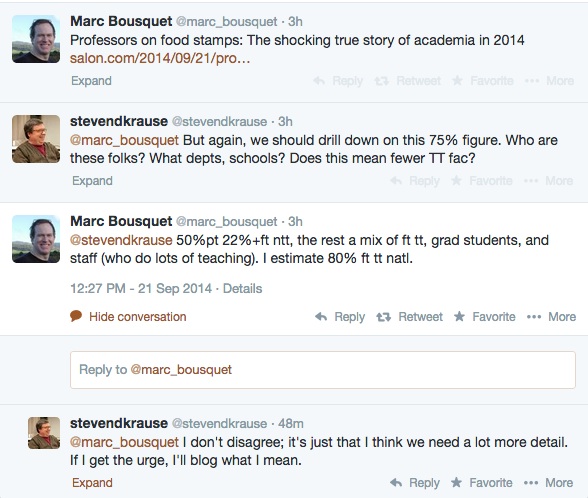
“75% (more or less) of college professors are not tenure track:” can we get more specific on that?

This post was born out of this exchange with Marc Bousquet:

MeandMarcTwitterAs I say here, I don’t disagree with the often cited figure that 75% of instructors in higher education are are not tenure track, and it’s certainly not that I think everything is hunky-dory on the good ship academia. It’s just that I think this needs to be unpacked a bit.

Continue reading ““75% (more or less) of college professors are not tenure track:” can we get more specific on that?”

Enough with the “no laptops in classrooms” already

There has been a rash of “turn off the laptop” articles in various places in the educational media, but I think what has pushed me over the edge and motivated this post is Clay Shirky’s “Why I Just Asked My Students To Put Their Laptops Away” on Medium. In the nutshell, Shirky went to the no laptop camp because (he says) students can’t multitask and students are too easily distracted by the technology, particularly with the constant alerts from things like Facebook.

Enough already.

First off, while I am no expert regarding multitasking, it seems to me that there are a lot of different layers to multitasking (or perhaps it would make more sense to say attention on task) and most of us perform some level of multitasking all the time.  Consider driving. I think it’s always a bad idea to be texting while actually moving in traffic because, yes, that’s too much multitasking for most people. But how about texting or checking email or social media while at a long light? I do it all the time. Or how about talking on the phone? For me, it’s easy to talk on the phone while driving if I am using headphones or if I’m driving a familiar route in normal conditions. When I’m driving an unfamiliar route in bad weather or in heavy traffic, not so much.

Second, distraction and not paying a lot of attention in class isn’t exactly new. When I was in high school, I sat in the back of the room in that chemistry class I was required to take and I read paperbacks “hidden” under the table. Students used to pass these things called “notes” on paper. Students did and still do whisper at each other in distracting ways. As both a college student and as a college teacher (certainly as a GA way back when), I’ve been with/had students who were distracted by and multitasking with magazines, newspapers, other people, with napping, etc., etc.

I agree with Shirky and some of the articles he cites that what’s interesting and different about contemporary electronic devices generally and social media in particular is that these are designed to distract us, to break our concentration. I routinely experience the sort of instant and satisfying gratification suggested in the abstract of this article. But to suggest that teachers/professors can solve this attention problem by asking students to temporarily turn off their laptops and pay attention to the sage on the stage strikes me as both naive and egotistical.

So here are three tips for Clay and other would-be haters for how to mentally adjust to the inevitability of laptops in their classrooms.

Number one, stop lecturing so much. When professors take the “stand and deliver” approach to “teaching,” the laptops come out. And why shouldn’t they? In an era where anyone can easily record a video and/or audio of a lecture that can be “consumed” by students on their own time, why should they sit and pay attention to you droning on?

I realize this is easy for me to say since I teach small classes with 25 of fewer students, but there are lots of ways to break up the talking head in a large lecture hall class too. Break students into groups to ask them to discuss the reading. Ask students to take a moment to write about a question or a reading and then ask them to respond.  Require your students to discuss and respond. Use the time in class to actually do work with the laptops (individually and collaboratively) to do things. Just stop thinking that teaching means standing there and talking at them.

Number two, be more interesting. If as a teacher (or really, just a speaker) you are noticing a large percentage of students not paying attention and turning to laptops or cell phones or magazines or napping, there’s a pretty good chance you’re being boring. I notice this in my own teaching all the time: when my students and I are interested in a conversation or an activity, the laptops stay closed. When I start to drone on or it otherwise starts getting boring, I see the checks on Facebook or Twitter or ESPN Sports or whatever. I use that as a cue to change up the discussion, to get more interesting.

Number three, “Let it Go.” Because here’s the thing: there’s really nothing professors can do (at least in the settings where I teach) to completely eliminate these kinds of distractions and multitasking and generally dumb stuff that students sometimes do. Students are humans and humans are easily distracted. So instead of spending so much time demanding perfect attention, just acknowledge that most of us can get a lot done with a laptop open. If you as the teacher are not the center of the universe, it’ll be okay.

Wanted: Assistant Professor, Rhetoric and Writing with an Emphasis in Technical Communication

I thought about combining this post with one about the job market in general and the differences between fields like composition and rhetoric and other fields in “the humanities” generally. And I just heard a story on NPR about the tough market for people with PhDs in the sciences for “postdocs” looking for tenure-track jobs I thought about reflecting on here. (Just to give it away a bit: academic careers for researchers are tough with all the cuts to funding, but the silver lining does appear to be work in the private sector for these folks).

But instead, I just want to pass along the ad and information about the search we have running in my program.  The ad itself is after the break; I’m not on the committee (anyone with questions about the position should contact Derek Mueller) and I am not speaking for EMU or anyone but myself. But I just wanted to share a couple thoughts about EMU and the area:

  • EMU is a great place to work. Oh sure, we have some of the funding problems of a lot of regional and MA granting kinds of institutions, but generally speaking, the finances and leadership have been pretty stable in recent years. The economy is improving in Michigan, so I’m crossing my fingers that some of that will trickle down from the state to higher education funding. EMU has a very strong faculty union, and I think that helps the working conditions a lot. This has some cons but the pros are pretty enormous in terms of setting the terms for work (both in terms of teaching load and what it takes to get tenure and promotion) and in terms of having a way to complain about problems. Let me put it this way: when I read about crazy things happening at other similar kinds of universities around the country– sudden increases in teaching load, “furloughs,” some sketchy hirings and firings, no way to grieve a problem, etc., etc.– I always think “that ain’t gonna happen at EMU.”
  • We’ve got great and interesting students. EMU comes out of the “Normal School” tradition and there are lots of education majors. But that’s been changing at EMU for a number of years, and increasingly, students come to EMU for all sorts of different programs, including our undergraduate and MA program in written communication. I would describe EMU as “opportunity granting” in that it isn’t as selective (or as expensive) as the University of Michigan or even Michigan State, but we’re not an “open admissions” university and everything we hear from admissions suggests we’re attracting students with higher high school GPAs and test scores. We’re kind of a commuter school and a returning student school, though there are a lot of traditional students living on campus too.
  • I’ve got fantastic colleagues. There are nine of us who are coming out of a “composition and rhetoric” sensibility in terms of training and teaching. That’s a big deal. My first job years and years ago at Southern Oregon University was a problem for a bunch of different reasons, but one of the biggest problems was I was “it” as far as the comp/rhet guy. There are a lot of jobs like that out there, and let me tell ya, that’s a lonely lonely space.
  • I also think this is a great opportunity because of where we are at with both our undergraduate and graduate program in writing. We have a well-established major and MA in writing, which means that whoever we hire isn’t going to have to invent the wheel. At the same time, we also are welcoming to new ideas and contributions in all kinds of different ways.
  • We’re right next to the University of Michigan– in fact, UM’s central campus is just over five miles away from EMU. The downside to this is that EMU is pretty much always overshadowed by “Big Blue.” When you’re at a party and you meet someone who is talking about working at “the university,” they don’t mean us. But the upsides are enormous. For example, faculty at EMU have the same borrowing privileges from the UM Library system as UM faculty (which reminds me I need to take some books back). And of course it’s really easy to partake in all of the various cultural, intellectual, and sporting things that come to the area because of Michigan.
  • It’s a great area to live, particularly Ann Arbor. Can’t sugar-coat the whole winter thing and last winter was the absolute worst. People I know who have lived here 40 years can’t remember it any colder. But besides the summers being great, it’s just a nice community. Ypsilanti has its pros and cons (I live in Ypsilanti, FWIW) as a kind of funky, artsy, blue-collar, rust-belt kind of place, less a “college town” than a small city on the outskirts of Detroit and the edges of Ann Arbor. For the travel-minded, we’re conveniently closer to the Detroit Metro airport than most of Detroit. And Ann Arbor itself is, in my view, great. It’s consistently voted one of the best places to live in America and one of the best college towns. Lots of great restaurants and shops and bars, a very vibrant downtown area, lots of festivals and events, great schools, not one but two Whole Foods, yadda, yadda, yadda. Given that a lot of universities and colleges are in the middle nowhere, I feel very lucky to be here.

Okay, enough from me. If you’re interested, check out the ad.

Continue reading “Wanted: Assistant Professor, Rhetoric and Writing with an Emphasis in Technical Communication”