Skip to content

Steven D. Krause

Writer, Professor, and Everything Else

  • CV
  • Semester Schedule (Present and Past)
  • Facebook
  • stevendkrause.substack.com
  • Instagram
  • Bluesky

Category: The Happy Academic

Posted on August 12, 2015August 12, 2015

Yes, I can think of a better way of spending 9 bucks (or, NCTE, please don’t sell my email address)

Yesterday morning, I received an email from my “good friend” NCTE Membership Services with the subject line “Can you think of a better way to spend 9 bucks?” I didn’t think anything of it and sent it to “archive” unread. Later that day, a professional colleague/friend had a bit of a rant posting on Facebook (which he has since deleted– his prerogative, of course) about this email and more generally about NCTE. So this morning, I thought I’d go find that archived NCTE email and figure out what all the fuss is about.

That “nine bucks” a month is for an “Educators Professional Liability Insurance” plan offered through Forrest T. Jones & Company, which is an insurance company that has been offering these plans for a long time.

This is what they are offering in Michigan:

  • The “Educators Professional Plan” offers “Personalized protection for educators who are employees of educational institutions….The plan pays all your defense costs in addition to liability limit for professional liability claims. It also provides job protection benefits if you’re subjected to a demotion, transfer, reassignment or dismissal.” I have my doubts about that last sentence.
  • Then there’s the “Private-Practice Professional Liability” plan, which probably does have some merit if you are indeed a “self-employed educator.” Of course, anyone working for any kind of school or university is not. Next.
  • Finally, there’s the “Student Educator Professional Plan,” which I guess is for students who are doing student teaching, practicums, internships, and so forth. The line here is that this is “required by many colleges and universities.” Maybe that’s true, but I’ve never heard of that and I would assume that the university is the one doing the insuring of the student.

So, two basic observations:

First, while I am not a lawyer and I am not offering any sort of legal advice or insurance advice, the idea that your average NCTE member (that is, a K-12 teacher or a college professor) needs any of this insurance is dubious.

I’m in a faculty union here at EMU, and in any of these professional liability scenarios, I am certain that they would step in. Besides that, all of the examples they give where this insurance would be justified seem to me to be covered by the school’s insurance– that is, a student gets injured in a classroom or something goes wrong on a field trip. And the example of a student suing a teacher because of a bad grade– please, show me the court case where that actually happened.

When I did a search for “do teachers need professional liability insurance” or “teacher liability insurance scam,” I founds some interesting results. There’s this response from a Texas insurance lawyer who argues it’s a waste of money and, if anything, will make the plaintiff go after the teacher instead of just the school.  There’s this article that is actually a critique of the Michigan Education Association: basically, the MEA argues that one of the big benefits of being in their union is the liability coverage, but this “exposé” of sorts says that’s bull. Here’s a long quote that I think speaks to the lack of need for this insurance:

“That is one of the ‘top shelf’ benefits that they tout for being a member,” said James Perialas, president of the Roscommon Teachers Association, an independent teachers union that was created in 2012 when teachers voted to decertify from the MEA and form a local union.

Perialas said the MEA doesn’t come out and say it is the sole provider of liability insurance for teachers, but implies that it is.

“That is not only false, but is inherently misleading to teachers in the union. A teacher’s primary line of defense is his/her school district. They all purchase a liability policy that covers employees,” Perialas said. “Furthermore, many Roscommon teachers have purchased professional liability insurance through their homeowner’s policy, for approximately $25 a year if they want additional coverage. If they are still not satisfied, the teacher-specific liability insurance can be had with membership in organizations like the Christian Educator’s Association, or the Association of American Educators. I am a member of the AAE, and it also provides litigation insurance if I need a lawyer for a wrongful discharge.

And then there’s this piece about teacher liability insurance in Florida, where this time the union there takes the opposite view. The issue there was there was a proposal making its way through the legislature that would require the state Department of Education to run an insurance program. Here’s a quote from that article:

“The last time the state offered this liability insurance, it cost taxpayers $4 million and paid out one claim,” said Mark Pudlow, a spokesman for the Florida Education Association. “This is wasteful spending. There are many other places in public schools that could better use whatever dollars are spent on this.”

The Florida Education Association offers liability insurance, and Pudlow said all 140,000 members are covered by that program. Pudlow said his organization has not experienced an uptick in claims in recent years.

So again, IANAL, this isn’t legal advice, find out for yourself, etc., etc., but no, the vast majority of teachers in this country don’t need this insurance.

Which leads me to my second point: NCTE, you should be a better organization than this. 

As it is, NCTE charges its 30,000 or so members between $22 (for students) and $50 a year for membership, and then, if you want to go to one of the organization’s conferences (which is the only reason why I’m a member of NCTE in the first place) it’s another $100-$150. So with this amount of revenue coming in– not to mention the organization’s books, journals, teaching materials, and God only knows what else– is it really necessary to squeeze a few more bucks out of members by selling a list of member emails to an insurance company?

And besides, this isn’t professionally responsible. A big part of what Forest T. Jones & Co. is buying from NCTE (besides the mailing list itself) is the ethos of the organization: that is, NCTE members (and frankly, this particularly applies to newer and more naive members) are being told by this professional organization that this insurance plan is a good idea– certainly a good way to spend $9 a month.  I’m not comfortable with that.

So my friend, NCTE Membership Services, please stop it. I don’t have a problem with you emailing me about dues, about upcoming conferences, or about upcoming publications coming out from NCTE and related presses and organizations. But if you’re going to include me on a mass email you send out, please let it be something that isn’t this spammy. Thanks.
Posted on July 27, 2015July 27, 2015

I am not sure what Kevin Carey is imagining here….

I started this on Sunday night while a bunch of folks were at my house playing a very very involved board game called Civilization. I did not play along. It is a long story, but the short version is I instead cooked what turned out to be a pretty good and more elaborate than I was planning dinner, and when it comes to playing games generally, I really have to be in the right mood and with the right game. I like game theory a lot more than actual games.

Anyway, late in the night while they were playing (the game went on for about 10 hours and still hadn’t finished), I got around to reading Kevin Carey’s New York Times Op-Ed “The Fundamental Way That Universities Are an Illusion.” I came to it via a commentary from a response Cathy Davidson had on HASTAC, “Universities are No More Illusory Than Journalists: Rsp to Kevin Cary and NYT,”  and also on Facebook.

Carey opens with the story of an athletic scandal at UNC where student athletes were taking classes that were technically legitimate classes but where the lack of recognizable requirements (like not having to attend) helped the less scholarly of student athletes to stay eligible for sports. It seems to me that stories like this cheating scandal pop up every few years, but that’s a problem of college sports and not “college” generally, and probably a different post. Then Carey writes:

Most colleges, presumably, aren’t harboring in-house credit mills. Yet in its underlying design, organizational values and daily operations, North Carolina is no different from most other colleges and universities. These organizations are not coherent academic enterprises with consistent standards of classroom excellence. When it comes to exerting influence over teaching and learning, they’re Easter eggs. They barely exist.

Let’s try to walk through that logic for a moment:

  • Big-time college sports tempt coaches, students, and even sympathetic professors/fans to create “in-house credit mills.”
  • While most colleges (presumably) don’t have a lot of this kind of problem, the design, value, and operation of most other colleges are “no different” from the school where these fake courses happened.
  • Therefore (I guess?), colleges/universities are “not coherent” when it comes to consistency, standards, classroom excellence, and influencing teaching and learning practices.

So for me, part of this is “well, duh,” that there is cheating in big-time college athletics. Obviously. As Davidson points out in her post, what Carey’s example demonstrates is a problem with college sports rather than college. But why would Carey (or anyone else) think that from this example it logically follows that the colleges across the board have no consistency/standards/oversight when it comes to teaching and learning practices? I know op-ed commentators are fond of the hasty generalization fallacy, but this seems a bit of a reach even for Carey.

Having read Carey’s book The End of College (and one of these days, I’ll blog a more extensive review of that), I think I know where he’s trying to go here. In his book, one of the main problems Carey has with higher education are the damn professors because professors are too independent, too lazy, too focused on their research, too indifferent to teaching, too petty, etc. So in Carey’s view, there’s no coherence or standards in higher education– that’s why it’s an illusion– in large part because professors get away with doing whatever it is they want to do. More on that in a moment.

But at the same time, Carey argues here that the college experience doesn’t vary much between schools. Carey wants to make this argument because one of the other points he hammers on in The End of College is that college rankings are way out of control. He cites Ernest Pascarella and Patrick Terenzini, authors of How College Affects Students, which appears to be a giant and long-standing study on the question of (duh) how college affects students.  Carey writes:

“The great majority of postsecondary institutions appear to have surprisingly similar net impacts on student growth,” the authors write. “If there is one thing that characterizes the research on between-college effects on the acquisition of subject matter knowledge and academic skills, it is that in the most internally valid studies, even the statistically significant effects tend to be quite small and often trivial in magnitude.”

And a little later:

 People can learn a lot in college, and many do. But which college matters much less than everyone assumes. As Mr. Pascarella and Mr. Terenzini explain, the real differences exist at the departmental level, or within the classrooms of individual professors, who teach with a great deal of autonomy under the principles of academic freedom. The illusory university pretends that all professors are guided by a shared sense of educational excellence specific to their institution. In truth, as the former University of California president Clark Kerr observed long ago, professors are “a series of individual faculty entrepreneurs held together by a common grievance over parking.”

If it’s true that at the level of big data that there isn’t much difference between different four year colleges– that is, you put all the undergraduate students attending “traditional” universities that grant bachelors degrees and those students come out statistically close to the same– then that means that there actually is a lot of consistency and coherence in higher education. And broadly speaking, I think this is true: that is, I believe that the experiences that EMU graduates have in terms of personal growth, subject knowledge, and academic skills are similar to those of University of Michigan graduates (though of course, individual results vary quite a bit). In other words, because the best available research suggests that there is a lot consistency, coherence, and statistical similarity between between different universities, there is no need for the mandated standardization and regulation Carey implies is necessary to make the college a less “illusionary.” Indeed, it isn’t an illusion at all.

But I want to dwell on that second paragraph I quote here because it demonstrates the problems I see with Carey’s “logic” generally. He begins with a claim that I think most people in higher education would actually agree with, that most people learn a lot in college regardless of what college they attend. Then he slips into a claim that the differences that exist within higher ed are a result of the “autonomy” and “academic freedom” of individual professors, and those professors are not “guided by a shared sense of educational excellence” at all. Rather, these damn individual professors are all just a bunch selfish entrepreneurs who bitch and complain about parking. Jeesh.

As Davidson points out in her post, if we’ve learned anything from the “No Child Left Behind” nonsense forced on to K-12 in this country, the absolute last thing we need is more regulation to curtail individual approaches to teaching, autonomy, and academic freedom. As she writes, “We are already so regulated, credentialized, rule-bound, bureaucratized, accredited, credentialized, governing bodied, politicized, overseen, and structured that radical reformation–which is what we really need–is extremely difficult.”

But beyond that, who are these “professors?” Depending on how you define permanent work and the “tenure track” in higher education, at least 70% (maybe more) of the folks doing the teaching aren’t professors at all; rather, they are graduate students, part-timers, and full-time instructors who might enjoy job security through renewable contracts (or not– some full-timers are on contracts that are not renewable after 3-5 years). These folks are not professors in that they are not usually required to do the research and service/administrative work of professors (that’s certainly the case at EMU), and, for better or worse, they don’t enjoy the level of autonomy and academic freedom of professors. Take our first year writing program, for example, one that is similar to a lot of first year writing programs in that almost everyone teaching classes in it are not professors (full disclosure: I’m the interim associate director of that program right now). We have specific outcomes we expect everyone teaching the class to get their students to meet, and we have a curriculum that offers teachers options but only within the expectations of the course. We wouldn’t hire (or rehire) folks who weren’t willing or able to teach within those expectations. I can’t claim that this level of “programming” and “control” exists across the board in other disciplines, but I’m certain it isn’t “anything goes” for most of the non-professors doing most of the teaching in universities nowadays.

Further, Carey’s assumption about the level of autonomy professors (as in the 30% or so of us who are on the tenure-track) have in their teaching is wrong too. Davidson wrote a LONG comment on her own blog post outlining the steps that are pretty typical for getting a new course approved at a university, a process that more or less squares with my experiences here at EMU. The same kind of bureaucracy is in place for degree programs and any significant change to a course or a degree program. I wish I worked in the environment Carey imagines for me.

I guess what bothers me the most about Carey’s views here and in other places, notably in The End of College, is the amount of airtime it gets in places in the mainstream media like The New York Times. He purposefully sets up the most visible part of higher education– professors– as the sole problem, conveniently skipping past the bloated administrations and edu-entrepreneurs that are profiting the most from out of control tuition. He is a self-described education policy wonk who (surprise, surprise!) thinks that the problems in higher education can be solved with more strident and controlling policies and regulations.   He’s tapping into the lizard brain general public “I’m mad as hell and I’m not going to take it anymore” sentiment that always exists since things are always getting worse, and he does this by making sweeping generalizations that have truthiness to them but that are demonstrably wrong. The problem is it’s very difficult to change people’s lizard brain minds with actual logic and evidence.

Though Carey is right about one thing: the complaint that unites all of academia has to do with parking.

Posted on July 17, 2015July 17, 2015

A short vacation post about academics on Twitter, @saragoldrickrab, and what our students don’t know

I’m on a vacation/family trip right now, and even while “away,” I tend to get up early and I’m currently enjoying a bit of peace and quiet. Almost all of the other 17 or so people sharing this giant vacation house are still asleep. So I thought I’d take a little time– just a little– to offer a few more thoughts about the Twitter conversation I had this morning. And let me apologize up front for not having all the details of this particular dust-up, for typing quickly (and thus with typos and bad sentences), etc.:

The latest installment of academics gone wild and/or “getting in trouble” on Twitter comes from CHE, “U. of Wisconsin Professor’s Tweets Draw Criticism From Her Own Colleagues.” Seems fitting since I actually am in Wisconsin right now. Anyway, the “naughty” tweeter in question is Sara Goldrick-Rab, who is a Professor at the University of Wisconsin who specializes in Education Policy. Here’s a quote from the article:

To several students who had tweeted their excitement about enrolling at Madison under the hashtag #FutureBadgers, Ms. Goldrick-Rab sent a link to an op-ed essay from the Journal Sentinel criticizing the removal of tenure protection from state statutes. Here are some of the responses she got:

Here CHE includes some response Tweets– here’s a link to that— where basically some not so informed college kids respond “ha ha we don’t care” and other nonsense. This was like a month ago. Then the College Republicans got involved a month later, in part because Goldrick-Rab kept on going and tweeted “My grandfather, a psychologist, just walked me through similarities between Walker and Hitler. There are so many- it’s terrifying.” This caused more outrage, more attacks on Goldrick-Rab on Twitter, and condemnation of Goldrick-Rab from both the UW Chancellor and the Executive Committee of the Faculty Senate.

And then, like I said, I stumbled into a spirited and pleasant Twitter conversation about some of this this morning.

So, a few thoughts in not a very precise order:

  • The general public doesn’t understand tenure or the difference between what it means to be a professor, an associate professor, an assistant professor, a non-tenure-track professor/instructor/lecturer, part-timer, or a graduate assistant, all of which is to say that the general public does not understand why all these professors in Wisconsin are in such a tizzy about weakening tenure. So it is not at all surprising to me that some 18 year old young people “stoked” about being admitted to UW think it is uncool for sara to kill their buzz with some sort of newspaper article, man. Because even though Goldrick-Rab is completely right, academics in Wisconsin (really, everywhere) have A LOT more work to do to explain to our students and the public at large how this all works and why this matters. A lot more work.

Most of what academics take as “common knowledge” about how higher ed works is a mystery to the rest of the world. I can recall times where some of these issues have come up informally in class discussions over the years– sometimes during faculty union contract negotiations– and I’ve taken five minutes to explain to a room full of juniors and seniors some of the basics of higher ed hierarchies, not only about faculty but also administrators. For most of my students– juniors and seniors,  mind you!– this is all new information. So again, while Goldrick-Rab is completely right, she made the faulty assumption that her audience of stoked would-be freshmen would actually understand her references to this op-ed.

  • The second mistake I think Goldrick-Rab made is the comparison to Hitler, and actually, as a general rule of thumb, I think any argument that makes a comparison to Hitler, the Nazis, the Holocaust, etc. to a contemporary figure– as in “Scott Walker is like Hitler”– is lazy and it’s going to cause trouble. This “x is like Hitler” trope shows up so much on Twitter because it’s shorthand and you only have 140 characters. The problem is it’s not accurate– I am no fan of Scott Walker, but I don’t think he’s likely to wage an aggressive war of domination in Europe and a systematic extermination of the Jews– and it can be taken way out of context by a group like College Republicans, who are already probably sensitive enough to informally being compared to Nazis. Anyway, my first piece of advice to any would-be academic Twitter-er: no Hitler comparisons.
  • Two other bits of advice to would-be academic Tweeters (and this is a bit of a tangent, but it came up in my Twitter conversation this morning) I’ll mention. First, Twitter is a terrible place to try to discuss anything that is at all complex or controversial, and yet academics try to use it for that purpose all the time. This is why (IMO) online spaces like blogs are still relevant and useful: instead of trying to convey all this on Twitter, I just shared a link to this. Maybe not as many people will read all of my rant here, but I am less likely to be misunderstood and/or taken out of context.

Second, academics (and anyone else, for that matter) who take to Twitter to express strong (and controversial) beliefs can’t get too upset when they are held accountable in some fashion for expressing those beliefs, especially when those beliefs actually take more than 140 characters (sans Hitler references) to convey. Don’t get me wrong– I’m all for academic free speech and I’m not suggesting that Goldrick-Rab or Steven Salaita or any other academic ought to be fired over Tweets. I’m just saying that if an academic (or anyone else) posts provocative stuff on Twitter, they shouldn’t be too surprised if a) it offends people and/or b) the message gets passed around and gets out of the writer’s control in a hurry.

  • Having said all that, I think the executive committee of the University of Wisconsin faculty senate are behaving like a bunch of wimpy knuckleheads. First off, Goldrick-Rab didn’t tell those young people not to come to UW; she referred them to an op-ed piece in Milwaukee’s mainstream newspaper about the impact of Walker’s budget cuts and rollbacks/changes to tenure. These really are things that the faculty ought to be telling would-be students; keeping them in the dark doesn’t do the students any good and it kind of indirectly supports Walker et al’s decisions. Second, what the hell is the point of faculty senate if it isn’t going to defend the faculty’s right to speak? I’m sure there are some details I’m missing here, but as reported in CHE, these people are throwing one of their own ranks under the bus. That’s appalling.
Posted on June 12, 2015

Seven Observations About Why Tenure is not “All That”

There’s been a lot of talk in the social networks I travel about tenure lately because of the mess in Wisconsin. For example, there are these two pieces from the New York Times, “Unions Subdued, Scott Walker Turns to Tenure at Wisconsin Colleges” and “Tenure Firmly in Place, but Colleges Grow Wary of Lasting Commitments.” Both of these articles only mention in passing the real crisis, IMO, that of the enormous budget cuts that Walker et al are forcing in the UW system.

Also, I don’t think either of these articles makes it clear that the system in Wisconsin is also unique in that tenure was specifically protected by state law– that’s what Walker managed to change. Ultimately, I suspect there will still be a system of tenure within the UW system that is more akin to the way tenure works in other states. But because of all of the emphasis on tenure, I also have a feeling that Walker et al will be able to cram through these budget cuts without a lot of pushback.

In any event, all of this has had me thinking about tenure in general and also how it has impacted me specifically. Perhaps my seven observations are all kind of obvious to other academics, but I thought I’d write them down anyway. But before I get to these points, let me offer two very important caveats/disclaimers/preferences/whatever:

  • I am for tenure. I don’t think it’s a perfect system (obviously), but I think it’s better than the alternatives. And of course, I’ve been tenured at EMU since 2002 and a full professor since 2007, and I’m not giving up tenure anytime soon.
  • I think the stuff going on in Wisconsin is insane. I worry tremendously for my colleagues and the students in the UW system, and I also worry about some of what’s happening there spreading to other states. I mean, I never thought Michigan would follow Wisconsin’s lead as a “right to work” state, but that’s exactly what happened a few years ago. I sure as hell hope that Walker’s moves in higher education don’t catch on.

Okay, my seven (or so) observations: Continue reading “Seven Observations About Why Tenure is not “All That””

Posted on May 11, 2015May 11, 2015

Where Bauerlein Sorta/Kinda Has a Point: Office Hours and “Tutoring”

Mark Bauerlein’s latest piece in the New York Times, “What’s the Point of a Professor?” is too much of a troll to take too seriously. He’s just complaining about the “kids today” in college and how they are all so much more interested in careers and so not interested in sitting at the feet of master professors in order to build a personal philosophy of life, the universe, and everything.

For a more direct response to the problems of Bauerlein’s take on things, I direct you to two very smart blog posts.

  • “Kids Today: A Response to Mark Bauerlein” by Matt “Confessions of a Community College Dean” Reed, where Reed points out (among other things) that higher education is supposed to be about students and not professors and that Bauerlein’s ideal of students being “enthralled” by their professors is “creepy, patriarchal, and wrong.”
  • “I Will Not Be Lectured To. I’m Too Busy Teaching.” by Kevin “The Tattooed Professor” Gannon, where Gannon takes on assumptions about what both students and faculty look like.

I especially appreciate Gannon’s critique because he is highlighting one of the problems I see with a lot of the writing about MOOCs and/or the future of higher education– people like Kevin Carey in The End of College, and also like David Noble in his critique of what I would describe as “traditional online courses,” Digital Diploma Mills.

Without going into a lot of detail now, I think Bauerlein, Carey, Noble, etc. are assuming as “the norm” that every other institution deviates from in one fashion or another is a big flagship state university or a famous Ivy league school– you know, the kinds of places that show up in the “top 20 universities in the world” lists. The fact of the matter is though that by definition, the vast vast VAST majority of community colleges, colleges, and universities are not “elite,” and the students and faculty at these places are similar but not the same as the students/faculty you find at elite institutions.

So while Bauerlein and Carey both assume that professors are “pointless” and not needed because they don’t teach much and/or are self-consumed with their research, Gannon goes to great length to explain the extremes of teaching and student involvement at the school where he works, Grand View University (he cheekily describes it as the Harvard of East Des Moines), where the teachings loads are high and the hands-on work with the small student body is extreme.

Anyway, go read those blog posts– smart stuff and I agree with both of them. But I wanted to take a slightly different view with Bauerlein’s essay and take up two things he brings up, more or less indirectly, that have to do with face to face interactions.

Continue reading “Where Bauerlein Sorta/Kinda Has a Point: Office Hours and “Tutoring””

Posted on April 27, 2015April 27, 2015

Post from sabbatical-land 126 days to go: dodging the administrator bullet & those lazy professors

I say “126 days to go” based on my self-declared date of September 1 as the end of my sabbatical, but this isn’t entirely true. Technically, my sabbatical was only for the winter (what everyone else calls spring) term, and since today is the last day of finals for this term at EMU, I suppose you could say that today is the end of my sabbatical.

Anyway, on the “dodging the administrator bullet” part of things: I applied for an administrative position here at EMU, as the Director of the Faculty Development Center, and it’s been quite a trip over the last couple of weeks.  I first mentioned the possibility of this here earlier in March and over at EMUTalk when I talked about closing down that site. I’m still going to be phasing EMUTalk out because it’s too much of a time-suck and it’s too much me (and that’s what this blog is for), but this is what I had in mind when I said “I might apply for an administrator job.”

Most of this is a matter of public record (which is why I’m comfortable about blogging about this at all), but needless to say, I’m not going into too much detail about the actual search process. Let’s just say I found myself as a finalist, I thought the interview process went well, the powers that be hired Peggy Liggit (who was the interim director), and I couldn’t be more relieved.

Part of my relief has to do with the job itself– I’ll skip the details of what I mean on that point. But most of my relief has to do with what I guess I’d describe as a realization that becoming an administrator would be a bad idea for me. It was sort of a mini midlife crisis. I first applied for the position because I thought I was qualified (and the fact that I was a finalist for the job suggests that I was qualified), I thought it might be interesting, and I liked the idea of the pay raise. But as the process went on, the more I saw the negatives of giving up my freedom, the ability to work at home (or coffee shops or wherever) while wearing jeans and t-shirt, the flexibility of not having to be in an office 40 hours a week, my summers. I started to realize I was going to end up doing a whole lot less scholarship and probably no teaching and instead I was going to go to a lot of meetings. Maybe I would have felt differently if I wasn’t sabbaticalling right now and if I had been waist-deep in grading and the like. In any event, about a month after I had first applied and while the interviews were happening, I started regretting applying at all. I mean like really really regretting it.

But like I said, in the end it wasn’t to be me, I couldn’t be happier, and I’m (almost completely) sure I won’t be doing that again. Of course, I probably would have never reached that realization had I not actually applied for the job in the first place.

Anyway (and I’m not sure this is completely connected), I was thinking about my realization that it would be foolish for me to give up what I’ve got– even for a lot more money– and a couple of these laws that have been floated lately to make professors “work more” and/or to vote them out of a job. There was the “8 courses a year” proposal in North Carolina by state senator Tom McInnis — here’s a CHE article about it— which would basically mandate a 4-4 load for every professor in the state schools, including the research universities. Then there’s the proposal from State Senator Mark Chelgren in the Iowa state congress where faculty would be evaluated solely on student evaluations– a professor not meeting some threshold of performance on these evaluations would be fired– and where the five professors who scored above this minimal threshold but the lowest would be fired. CHE has an interview with this winner of a politician here.

Of course, both of these plans are bad, though I have to say that the angry backlash reported in that CHE article about the “8 courses a year” proposal is perhaps a little over the top. Sure, if you’re teaching at an R1 and are expected “book plus” and/or lots of grant writing and the like for tenure and even more for promotion, a 4-4 load is a lot. We technically teach a 4-4 load here at EMU and there are some departments where faculty do teach four courses every semester. But because of a series of what are called “course equivalencies,” most faculty teach something closer to a 3-3 load (that’s what we teach in my department), and there is course release/reassigned time for doing quasi-administrative work and the like. But the point I am trying to make here is that lots of faculty at lots of “less than” R1 institutions teach eight courses a year or more.

And the “vote them off the island” plan from Chelgren is based on an actual problem: it is pretty much impossible to get rid of bad professors who are tenured, especially over something like bad teaching. Don’t get me wrong: the vast vast majority of professors are good at what they do in large part because it takes a lot to get these positions. But every department has a few bad apples– old, tenured, dried-up apples– and it doesn’t really matter how terrible the student evaluations are. So as ill-informed as Chelgren is, I kind of see where he’s coming from.

Both of these proposals are also variations on the “lazy professor who gets his summers off” view of academia.  This is a view that is of course inaccurate and it tends to be held by not very educated people and also by people who are kind of envious of the lifestyle. What I mean is sure, I work a lot, but I also enjoy the freedom to do the work I want to do and I can do that work mostly wherever I want. So I guess one of the big reasons why I’m not leaving my faculty job for administrative work anytime soon is so I can continue to tick off people like McInnis and Chelgren.

Posted on September 21, 2014

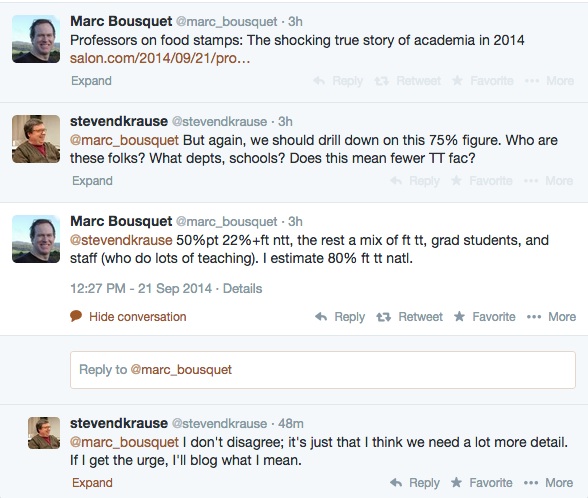
“75% (more or less) of college professors are not tenure track:” can we get more specific on that?

This post was born out of this exchange with Marc Bousquet:

MeandMarcTwitterAs I say here, I don’t disagree with the often cited figure that 75% of instructors in higher education are are not tenure track, and it’s certainly not that I think everything is hunky-dory on the good ship academia. It’s just that I think this needs to be unpacked a bit.

Continue reading ““75% (more or less) of college professors are not tenure track:” can we get more specific on that?”

Posted on September 20, 2014September 21, 2014

Enough with the “no laptops in classrooms” already

There has been a rash of “turn off the laptop” articles in various places in the educational media, but I think what has pushed me over the edge and motivated this post is Clay Shirky’s “Why I Just Asked My Students To Put Their Laptops Away” on Medium. In the nutshell, Shirky went to the no laptop camp because (he says) students can’t multitask and students are too easily distracted by the technology, particularly with the constant alerts from things like Facebook.

Enough already.

First off, while I am no expert regarding multitasking, it seems to me that there are a lot of different layers to multitasking (or perhaps it would make more sense to say attention on task) and most of us perform some level of multitasking all the time.  Consider driving. I think it’s always a bad idea to be texting while actually moving in traffic because, yes, that’s too much multitasking for most people. But how about texting or checking email or social media while at a long light? I do it all the time. Or how about talking on the phone? For me, it’s easy to talk on the phone while driving if I am using headphones or if I’m driving a familiar route in normal conditions. When I’m driving an unfamiliar route in bad weather or in heavy traffic, not so much.

Second, distraction and not paying a lot of attention in class isn’t exactly new. When I was in high school, I sat in the back of the room in that chemistry class I was required to take and I read paperbacks “hidden” under the table. Students used to pass these things called “notes” on paper. Students did and still do whisper at each other in distracting ways. As both a college student and as a college teacher (certainly as a GA way back when), I’ve been with/had students who were distracted by and multitasking with magazines, newspapers, other people, with napping, etc., etc.

I agree with Shirky and some of the articles he cites that what’s interesting and different about contemporary electronic devices generally and social media in particular is that these are designed to distract us, to break our concentration. I routinely experience the sort of instant and satisfying gratification suggested in the abstract of this article. But to suggest that teachers/professors can solve this attention problem by asking students to temporarily turn off their laptops and pay attention to the sage on the stage strikes me as both naive and egotistical.

So here are three tips for Clay and other would-be haters for how to mentally adjust to the inevitability of laptops in their classrooms.

Number one, stop lecturing so much. When professors take the “stand and deliver” approach to “teaching,” the laptops come out. And why shouldn’t they? In an era where anyone can easily record a video and/or audio of a lecture that can be “consumed” by students on their own time, why should they sit and pay attention to you droning on?

I realize this is easy for me to say since I teach small classes with 25 of fewer students, but there are lots of ways to break up the talking head in a large lecture hall class too. Break students into groups to ask them to discuss the reading. Ask students to take a moment to write about a question or a reading and then ask them to respond.  Require your students to discuss and respond. Use the time in class to actually do work with the laptops (individually and collaboratively) to do things. Just stop thinking that teaching means standing there and talking at them.

Number two, be more interesting. If as a teacher (or really, just a speaker) you are noticing a large percentage of students not paying attention and turning to laptops or cell phones or magazines or napping, there’s a pretty good chance you’re being boring. I notice this in my own teaching all the time: when my students and I are interested in a conversation or an activity, the laptops stay closed. When I start to drone on or it otherwise starts getting boring, I see the checks on Facebook or Twitter or ESPN Sports or whatever. I use that as a cue to change up the discussion, to get more interesting.

Number three, “Let it Go.” Because here’s the thing: there’s really nothing professors can do (at least in the settings where I teach) to completely eliminate these kinds of distractions and multitasking and generally dumb stuff that students sometimes do. Students are humans and humans are easily distracted. So instead of spending so much time demanding perfect attention, just acknowledge that most of us can get a lot done with a laptop open. If you as the teacher are not the center of the universe, it’ll be okay.

Posted on September 16, 2014

Wanted: Assistant Professor, Rhetoric and Writing with an Emphasis in Technical Communication

I thought about combining this post with one about the job market in general and the differences between fields like composition and rhetoric and other fields in “the humanities” generally. And I just heard a story on NPR about the tough market for people with PhDs in the sciences for “postdocs” looking for tenure-track jobs I thought about reflecting on here. (Just to give it away a bit: academic careers for researchers are tough with all the cuts to funding, but the silver lining does appear to be work in the private sector for these folks).

But instead, I just want to pass along the ad and information about the search we have running in my program.  The ad itself is after the break; I’m not on the committee (anyone with questions about the position should contact Derek Mueller) and I am not speaking for EMU or anyone but myself. But I just wanted to share a couple thoughts about EMU and the area:

  • EMU is a great place to work. Oh sure, we have some of the funding problems of a lot of regional and MA granting kinds of institutions, but generally speaking, the finances and leadership have been pretty stable in recent years. The economy is improving in Michigan, so I’m crossing my fingers that some of that will trickle down from the state to higher education funding. EMU has a very strong faculty union, and I think that helps the working conditions a lot. This has some cons but the pros are pretty enormous in terms of setting the terms for work (both in terms of teaching load and what it takes to get tenure and promotion) and in terms of having a way to complain about problems. Let me put it this way: when I read about crazy things happening at other similar kinds of universities around the country– sudden increases in teaching load, “furloughs,” some sketchy hirings and firings, no way to grieve a problem, etc., etc.– I always think “that ain’t gonna happen at EMU.”
  • We’ve got great and interesting students. EMU comes out of the “Normal School” tradition and there are lots of education majors. But that’s been changing at EMU for a number of years, and increasingly, students come to EMU for all sorts of different programs, including our undergraduate and MA program in written communication. I would describe EMU as “opportunity granting” in that it isn’t as selective (or as expensive) as the University of Michigan or even Michigan State, but we’re not an “open admissions” university and everything we hear from admissions suggests we’re attracting students with higher high school GPAs and test scores. We’re kind of a commuter school and a returning student school, though there are a lot of traditional students living on campus too.
  • I’ve got fantastic colleagues. There are nine of us who are coming out of a “composition and rhetoric” sensibility in terms of training and teaching. That’s a big deal. My first job years and years ago at Southern Oregon University was a problem for a bunch of different reasons, but one of the biggest problems was I was “it” as far as the comp/rhet guy. There are a lot of jobs like that out there, and let me tell ya, that’s a lonely lonely space.
  • I also think this is a great opportunity because of where we are at with both our undergraduate and graduate program in writing. We have a well-established major and MA in writing, which means that whoever we hire isn’t going to have to invent the wheel. At the same time, we also are welcoming to new ideas and contributions in all kinds of different ways.
  • We’re right next to the University of Michigan– in fact, UM’s central campus is just over five miles away from EMU. The downside to this is that EMU is pretty much always overshadowed by “Big Blue.” When you’re at a party and you meet someone who is talking about working at “the university,” they don’t mean us. But the upsides are enormous. For example, faculty at EMU have the same borrowing privileges from the UM Library system as UM faculty (which reminds me I need to take some books back). And of course it’s really easy to partake in all of the various cultural, intellectual, and sporting things that come to the area because of Michigan.
  • It’s a great area to live, particularly Ann Arbor. Can’t sugar-coat the whole winter thing and last winter was the absolute worst. People I know who have lived here 40 years can’t remember it any colder. But besides the summers being great, it’s just a nice community. Ypsilanti has its pros and cons (I live in Ypsilanti, FWIW) as a kind of funky, artsy, blue-collar, rust-belt kind of place, less a “college town” than a small city on the outskirts of Detroit and the edges of Ann Arbor. For the travel-minded, we’re conveniently closer to the Detroit Metro airport than most of Detroit. And Ann Arbor itself is, in my view, great. It’s consistently voted one of the best places to live in America and one of the best college towns. Lots of great restaurants and shops and bars, a very vibrant downtown area, lots of festivals and events, great schools, not one but two Whole Foods, yadda, yadda, yadda. Given that a lot of universities and colleges are in the middle nowhere, I feel very lucky to be here.

Okay, enough from me. If you’re interested, check out the ad.

Continue reading “Wanted: Assistant Professor, Rhetoric and Writing with an Emphasis in Technical Communication”

Posted on August 22, 2014August 22, 2014

What and why do students and faculty (and anyone else) want to and not want to write?

I read two different education media articles the other day that both spoke to me in oddly similar ways about the reasons for (or for not) writing. First there was from IHE, “What Students Write,” which is a sort of review/essay about Dan Melzer’s book, Assignments Across the Curriculum: A National Study of College Writing. The article is good and the book sounds great. The very short version (based on just the article) is that Melzer studied over 2100 different writing assignments across the curriculum at about 100 different institutions. Not surprisingly, most of the writing assignments teachers give are shitty, mostly an exercise for students to prove to the teacher that they can repeat back in a written text (an essay, an exam, etc.) what was in the lecture and/or reading.

Melzer calls this largest category of writing assignments “student to examiner;” I would more cheekily call it “parroting,” or “Polly wants a cracker” writing. Oh, and students better repeat what the teacher said correctly. Here’s a quote:

Short-answer and essay exams made up about one-fifth of assignments in the study. Melzer said in an interview that the testing scenario makes sense, given the constraints on professors’ time. Offering multiple opportunities for feedback in a non-test scenario takes a lot more work, he said. But such opportunities are critical to writing development and lead to better student outcomes.

“There’s a lot more testing with the teacher-as-examiner going on than we probably think, and that’s a real negative to me because it’s such a limited kind of writing,” Melzer said. “It should make people think about how we can improve upon the situation and have student do richer kinds of writing.”

Professors are also “obsessed” with grammatical correctness, even when they claim to value critical thinking, the study says.

In the other corner comes this from CHE, “Anatomy of a Serial-Plagiarism Charge” about Mustapha Marrouchi, who is a postcolonial lit professor at the University of Nevada at Las Vegas. There’s more about the case in an article behind CHE’s firewall, but the gist is that Marrouchi has apparently been plagiarising to different degrees for decades, this despite the fact that he was enough of a “big shot” in the field to get hired away from a previously high-paid spot at Louisiana State to an even sweeter gig at UNLV. What the non-firewalled piece I’m linking to here does do is highlight a number of incidents that do look kind of fishy.

So, what do these two articles/incidents say about what it is that students and teachers write and read, what they want to write and read? A few thoughts:

I like to write and always have. Writing is one of the few things I am actually good at and I can recall being rewarded for my talent as far back as grade school. I like to read too, though like a lot of my students (especially the creative writing types), I like to write more.

I write and read every day, but I still have a hard time with “assigned” writing, meaning for me not assignments from a teacher (I’m not taking any classes) but writing I am supposed to be doing for some other reason. There are at least three projects I’m procrastinating on right now to write this post instead. The same goes with reading. There are a stack of academic books and novels I am supposed to be reading right now so I can be a better person and a good intellectual, not to mention to be prepared to teach in a couple of weeks. But I am more likely to be reading the links to things on Twitter or the listicles on Facebook about which Hollywood stars began their careers as strippers.

So I guess there are some ways in which these reports of lazy writing assignments and serial plagiarism are not that surprising to me. Like everyone else in my field, I try to develop writing assignments with a clear purpose and audience beyond just writing to me as the teacher and beyond just having students prove to me they did the reading and/or were otherwise paying attention. I do think it makes a difference. I think students learn more from such assignments, I find this writing a lot more pleasant to read and grade, and I think it helps students to not plagiarize. It’s a bit of a cliché, but I also think it’s true that there’s a difference between assigning writing and teaching writing.  So when professors give the sort of stupid assignments that Melzer is writing about in his book and with no actual teaching involved, it’s no wonder that those professors are disappointed and even angry about their students’ writing.  Garbage in, garbage out.

But good assignments aren’t a cure-all. Not everyone likes to write just to write, and students frequently don’t like to write and thus resist new assignments. I gave a talk back at the CCCCs in Louisville in 2010 (a talk I should probably assign myself to revisit and rewrite into a longer essay) about using the movie RiP! A Remix Manifesto as a topic and a guiding principle for teaching first year writing.  Among many other things, I said that while it is certainly more pedagogically effective and ethical to give writing assignments that are not parroting, many of my students ultimately reverted to writing five paragraph essays. When students do this, I think it is because it is the path of least resistance (it’s always easier doing something you’ve done rather than doing something you haven’t done before), but also because students don’t trust me. Perhaps for good reason. They’ve had years of previous school writing assignments where teachers obsessed over their repeating what the book/the teacher said and where they were dinged on the grade for grammar stuff. And the whole situation is by definition not “authentic” since it is writing assigned and tied to a grade. Students are “made” to do this– at least in the sense that it’s tied to requirements for a class and a grade. Even assignments that ask students to “self-reflect” on something on their own are still assigned.

Then there’s my cynical connection of assigned writing (bad assignments in particular) to Mustapha Marrouchi. I don’t know anything about him or his scholarly work beyond what I read in The Chronicle. But based on that reading, here’s a guy who has had quite the successful academic career by publishing convoluted literary and cultural theory liberally sprinkled with plagiarised and otherwise paraphrased quotes. He’s been doing this for years, and while he has apparently sort of/kind of been called on this before, he’s only just getting into serious trouble for this now. How did this happen and how did he get away with it that long? Is it possible that so few readers– academic or otherwise– read  Marrouchi’s work that no one really noticed it as a serious problem for more than 20 years? Did no one care?

And why did Marrouchi do this anyway? As the examples in that CHE piece make clear, it wouldn’t have taken a whole lot for Marrouchi to cite his sources, to write “as Terry Eagleton put it” or whatever. Was he as a writer just too lazy to cite his sources? Was much of Marrouchi’s scholarship the equivalent of the five paragraph drudgery assigned to him by academia so that he could get another line on his CV? What’s going on here?

I guess this gets me back to the question about what and why does anyone write anything. But I don’t really know the answer to my questions, not even for myself as a writer.  All I can say is do the best that you can with writing assignments, hoping for the best but understanding the inherent limitations of the rhetorical situation that is Education generally. Make all writing as engaging and as new and as thoughtful as possible.  Don’t make students do dumb assignments just so they can do dumb assignments that get some grade. Don’t write dumb and/or plagiarized scholarship just so you can write scholarship.

Posts pagination

Previous page Page 1 … Page 3 Page 4 Page 5 … Page 25 Next page

I'm a professor at Eastern Michigan University in Ypsilanti. Most of my teaching and scholarship focuses on the connections between writing and technology. Lately I have been teaching and reading and writing about AI, just like many folks in writing studies.

More than you probably want to know.

I've been blogging since 2004. In the old days, I posted a lot more often, but most of those early posts were things I'm more likely to post nowadays on Facebook, Substack, and/or Instagram.

I used to run a community blog site called EMUTalk.org. Nowadays, EMUTalk is a Facebook group.

Links

  • Annette Wannnamaker's Homepage
  • EMU Written Communication

Recent Comments

  • ben reynolds on It’s Not Brave to Piss People Off
  • Steve Krause on Post European Vacation: Random Thoughts
  • Ben Reynolds on Post European Vacation: Random Thoughts
  • Dennis Jerz on Now is a Good Time to be at a “Third Tier” University
  • Steve Krause on My Peter Elbow Story

Categories

Archives

Proudly powered by WordPress

Loading Comments...