Skip to content

Steven D. Krause

Writer, Professor, and Everything Else

  • CV
  • Semester Schedule (Present and Past)
  • Facebook
  • stevendkrause.substack.com
  • Instagram
  • Bluesky

Category: Academia

Posted on October 31, 2014October 31, 2014

“MOOCs as Liberators, MOOCs as Colonizers: A Dilemma” (my Cultural Rhetorics Conference Presentation)

Here is the text (more or less) and the slides for a presentation I’m giving on Friday as part of  the Cultural Rhetorics conference at Michigan State University, which is running on October 31 and November 1. I’m happy to be doing this because I want to support this first time conference and because it’s very local and on very friendly territory for me. The only bad thing is I’m presenting at the last session on the Friday of the conference (which is also Halloween!), so I’m not exactly expecting a standing room only kind of crowd. But we’ll see what happens. Anyway, I am making this post live just before my talk on Friday is underway. I am guessing I’ll have more to post about the conference a bit later.

Continue reading ““MOOCs as Liberators, MOOCs as Colonizers: A Dilemma” (my Cultural Rhetorics Conference Presentation)”

Posted on October 7, 2014

A blog post that will substitute for now for working on various MOOC projects

I am in the midst of what I have dubbed “sabbatical lite.” I finished up my quasi-administrative duties as program coordinator this summer and passed that baton on to Steve Benninghoff. This semester, I’m only teaching two classes because I’m getting a course release (more like payback) for MA projects I’ve directed over the last few years. Both of these are undergraduate courses and one of them is online. This is all setting the stage for my sabbatical proper, which will begin in January and go until next August.

It all makes me very nervous. I have had this song going through my head for weeks now:


Continue reading “A blog post that will substitute for now for working on various MOOC projects”

Posted on September 21, 2014

“75% (more or less) of college professors are not tenure track:” can we get more specific on that?

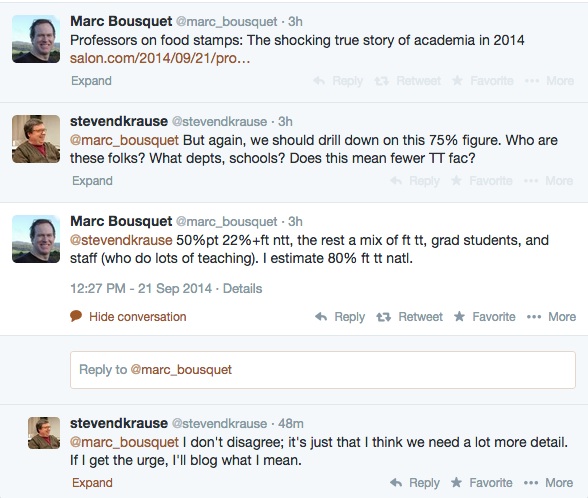
This post was born out of this exchange with Marc Bousquet:

MeandMarcTwitterAs I say here, I don’t disagree with the often cited figure that 75% of instructors in higher education are are not tenure track, and it’s certainly not that I think everything is hunky-dory on the good ship academia. It’s just that I think this needs to be unpacked a bit.

Continue reading ““75% (more or less) of college professors are not tenure track:” can we get more specific on that?”

Posted on September 16, 2014

Wanted: Assistant Professor, Rhetoric and Writing with an Emphasis in Technical Communication

I thought about combining this post with one about the job market in general and the differences between fields like composition and rhetoric and other fields in “the humanities” generally. And I just heard a story on NPR about the tough market for people with PhDs in the sciences for “postdocs” looking for tenure-track jobs I thought about reflecting on here. (Just to give it away a bit: academic careers for researchers are tough with all the cuts to funding, but the silver lining does appear to be work in the private sector for these folks).

But instead, I just want to pass along the ad and information about the search we have running in my program.  The ad itself is after the break; I’m not on the committee (anyone with questions about the position should contact Derek Mueller) and I am not speaking for EMU or anyone but myself. But I just wanted to share a couple thoughts about EMU and the area:

  • EMU is a great place to work. Oh sure, we have some of the funding problems of a lot of regional and MA granting kinds of institutions, but generally speaking, the finances and leadership have been pretty stable in recent years. The economy is improving in Michigan, so I’m crossing my fingers that some of that will trickle down from the state to higher education funding. EMU has a very strong faculty union, and I think that helps the working conditions a lot. This has some cons but the pros are pretty enormous in terms of setting the terms for work (both in terms of teaching load and what it takes to get tenure and promotion) and in terms of having a way to complain about problems. Let me put it this way: when I read about crazy things happening at other similar kinds of universities around the country– sudden increases in teaching load, “furloughs,” some sketchy hirings and firings, no way to grieve a problem, etc., etc.– I always think “that ain’t gonna happen at EMU.”
  • We’ve got great and interesting students. EMU comes out of the “Normal School” tradition and there are lots of education majors. But that’s been changing at EMU for a number of years, and increasingly, students come to EMU for all sorts of different programs, including our undergraduate and MA program in written communication. I would describe EMU as “opportunity granting” in that it isn’t as selective (or as expensive) as the University of Michigan or even Michigan State, but we’re not an “open admissions” university and everything we hear from admissions suggests we’re attracting students with higher high school GPAs and test scores. We’re kind of a commuter school and a returning student school, though there are a lot of traditional students living on campus too.
  • I’ve got fantastic colleagues. There are nine of us who are coming out of a “composition and rhetoric” sensibility in terms of training and teaching. That’s a big deal. My first job years and years ago at Southern Oregon University was a problem for a bunch of different reasons, but one of the biggest problems was I was “it” as far as the comp/rhet guy. There are a lot of jobs like that out there, and let me tell ya, that’s a lonely lonely space.
  • I also think this is a great opportunity because of where we are at with both our undergraduate and graduate program in writing. We have a well-established major and MA in writing, which means that whoever we hire isn’t going to have to invent the wheel. At the same time, we also are welcoming to new ideas and contributions in all kinds of different ways.
  • We’re right next to the University of Michigan– in fact, UM’s central campus is just over five miles away from EMU. The downside to this is that EMU is pretty much always overshadowed by “Big Blue.” When you’re at a party and you meet someone who is talking about working at “the university,” they don’t mean us. But the upsides are enormous. For example, faculty at EMU have the same borrowing privileges from the UM Library system as UM faculty (which reminds me I need to take some books back). And of course it’s really easy to partake in all of the various cultural, intellectual, and sporting things that come to the area because of Michigan.
  • It’s a great area to live, particularly Ann Arbor. Can’t sugar-coat the whole winter thing and last winter was the absolute worst. People I know who have lived here 40 years can’t remember it any colder. But besides the summers being great, it’s just a nice community. Ypsilanti has its pros and cons (I live in Ypsilanti, FWIW) as a kind of funky, artsy, blue-collar, rust-belt kind of place, less a “college town” than a small city on the outskirts of Detroit and the edges of Ann Arbor. For the travel-minded, we’re conveniently closer to the Detroit Metro airport than most of Detroit. And Ann Arbor itself is, in my view, great. It’s consistently voted one of the best places to live in America and one of the best college towns. Lots of great restaurants and shops and bars, a very vibrant downtown area, lots of festivals and events, great schools, not one but two Whole Foods, yadda, yadda, yadda. Given that a lot of universities and colleges are in the middle nowhere, I feel very lucky to be here.

Okay, enough from me. If you’re interested, check out the ad.

Continue reading “Wanted: Assistant Professor, Rhetoric and Writing with an Emphasis in Technical Communication”

Posted on August 22, 2014August 22, 2014

What and why do students and faculty (and anyone else) want to and not want to write?

I read two different education media articles the other day that both spoke to me in oddly similar ways about the reasons for (or for not) writing. First there was from IHE, “What Students Write,” which is a sort of review/essay about Dan Melzer’s book, Assignments Across the Curriculum: A National Study of College Writing. The article is good and the book sounds great. The very short version (based on just the article) is that Melzer studied over 2100 different writing assignments across the curriculum at about 100 different institutions. Not surprisingly, most of the writing assignments teachers give are shitty, mostly an exercise for students to prove to the teacher that they can repeat back in a written text (an essay, an exam, etc.) what was in the lecture and/or reading.

Melzer calls this largest category of writing assignments “student to examiner;” I would more cheekily call it “parroting,” or “Polly wants a cracker” writing. Oh, and students better repeat what the teacher said correctly. Here’s a quote:

Short-answer and essay exams made up about one-fifth of assignments in the study. Melzer said in an interview that the testing scenario makes sense, given the constraints on professors’ time. Offering multiple opportunities for feedback in a non-test scenario takes a lot more work, he said. But such opportunities are critical to writing development and lead to better student outcomes.

“There’s a lot more testing with the teacher-as-examiner going on than we probably think, and that’s a real negative to me because it’s such a limited kind of writing,” Melzer said. “It should make people think about how we can improve upon the situation and have student do richer kinds of writing.”

Professors are also “obsessed” with grammatical correctness, even when they claim to value critical thinking, the study says.

In the other corner comes this from CHE, “Anatomy of a Serial-Plagiarism Charge” about Mustapha Marrouchi, who is a postcolonial lit professor at the University of Nevada at Las Vegas. There’s more about the case in an article behind CHE’s firewall, but the gist is that Marrouchi has apparently been plagiarising to different degrees for decades, this despite the fact that he was enough of a “big shot” in the field to get hired away from a previously high-paid spot at Louisiana State to an even sweeter gig at UNLV. What the non-firewalled piece I’m linking to here does do is highlight a number of incidents that do look kind of fishy.

So, what do these two articles/incidents say about what it is that students and teachers write and read, what they want to write and read? A few thoughts:

I like to write and always have. Writing is one of the few things I am actually good at and I can recall being rewarded for my talent as far back as grade school. I like to read too, though like a lot of my students (especially the creative writing types), I like to write more.

I write and read every day, but I still have a hard time with “assigned” writing, meaning for me not assignments from a teacher (I’m not taking any classes) but writing I am supposed to be doing for some other reason. There are at least three projects I’m procrastinating on right now to write this post instead. The same goes with reading. There are a stack of academic books and novels I am supposed to be reading right now so I can be a better person and a good intellectual, not to mention to be prepared to teach in a couple of weeks. But I am more likely to be reading the links to things on Twitter or the listicles on Facebook about which Hollywood stars began their careers as strippers.

So I guess there are some ways in which these reports of lazy writing assignments and serial plagiarism are not that surprising to me. Like everyone else in my field, I try to develop writing assignments with a clear purpose and audience beyond just writing to me as the teacher and beyond just having students prove to me they did the reading and/or were otherwise paying attention. I do think it makes a difference. I think students learn more from such assignments, I find this writing a lot more pleasant to read and grade, and I think it helps students to not plagiarize. It’s a bit of a cliché, but I also think it’s true that there’s a difference between assigning writing and teaching writing.  So when professors give the sort of stupid assignments that Melzer is writing about in his book and with no actual teaching involved, it’s no wonder that those professors are disappointed and even angry about their students’ writing.  Garbage in, garbage out.

But good assignments aren’t a cure-all. Not everyone likes to write just to write, and students frequently don’t like to write and thus resist new assignments. I gave a talk back at the CCCCs in Louisville in 2010 (a talk I should probably assign myself to revisit and rewrite into a longer essay) about using the movie RiP! A Remix Manifesto as a topic and a guiding principle for teaching first year writing.  Among many other things, I said that while it is certainly more pedagogically effective and ethical to give writing assignments that are not parroting, many of my students ultimately reverted to writing five paragraph essays. When students do this, I think it is because it is the path of least resistance (it’s always easier doing something you’ve done rather than doing something you haven’t done before), but also because students don’t trust me. Perhaps for good reason. They’ve had years of previous school writing assignments where teachers obsessed over their repeating what the book/the teacher said and where they were dinged on the grade for grammar stuff. And the whole situation is by definition not “authentic” since it is writing assigned and tied to a grade. Students are “made” to do this– at least in the sense that it’s tied to requirements for a class and a grade. Even assignments that ask students to “self-reflect” on something on their own are still assigned.

Then there’s my cynical connection of assigned writing (bad assignments in particular) to Mustapha Marrouchi. I don’t know anything about him or his scholarly work beyond what I read in The Chronicle. But based on that reading, here’s a guy who has had quite the successful academic career by publishing convoluted literary and cultural theory liberally sprinkled with plagiarised and otherwise paraphrased quotes. He’s been doing this for years, and while he has apparently sort of/kind of been called on this before, he’s only just getting into serious trouble for this now. How did this happen and how did he get away with it that long? Is it possible that so few readers– academic or otherwise– read  Marrouchi’s work that no one really noticed it as a serious problem for more than 20 years? Did no one care?

And why did Marrouchi do this anyway? As the examples in that CHE piece make clear, it wouldn’t have taken a whole lot for Marrouchi to cite his sources, to write “as Terry Eagleton put it” or whatever. Was he as a writer just too lazy to cite his sources? Was much of Marrouchi’s scholarship the equivalent of the five paragraph drudgery assigned to him by academia so that he could get another line on his CV? What’s going on here?

I guess this gets me back to the question about what and why does anyone write anything. But I don’t really know the answer to my questions, not even for myself as a writer.  All I can say is do the best that you can with writing assignments, hoping for the best but understanding the inherent limitations of the rhetorical situation that is Education generally. Make all writing as engaging and as new and as thoughtful as possible.  Don’t make students do dumb assignments just so they can do dumb assignments that get some grade. Don’t write dumb and/or plagiarized scholarship just so you can write scholarship.

Posted on August 9, 2014August 9, 2014

Salaita and the limits (or lack thereof) of academic speech on social media

The latest installment in the story of academic freedom versus social media comes to us from one Steven Salaita. Here’s a long quote from this Salon piece, “Return of the blacklist?” that more or less sums up what seems to have happened to him:

A few weeks ago Steven Salaita had reason to be pleased.  After a full review by the University of Illinois at Urbana-Champaign, he had received a generous offer of a tenured, associate professor position there — the normal contract was offered, signed by the school, he had received confirmation of his salary, a teaching schedule, everything except the final approval of the UIUC chancellor.

In academia this is not at all unusual; departments and schools are told to go ahead with the offer, so as to be competitive with both the candidate’s current school and others that might be bidding for their talent.  Salaita is a world-renowned scholar of indigenous studies (and also a frequent Salon contributor). At that point, as required by academic protocols, upon accepting the position he resigned the one he held at Virginia Tech.

But final approval never came.  The Chronicle of Higher Education reports today that “Phyllis M. Wise, the campus’s chancellor, and Christophe Pierre, the University of Illinois system’s vice president for academic affairs, informed the job candidate, Steven G. Salaita, on Friday that they were effectively revoking a written offer of a tenured professorship made to him last year by refusing to submit it to the system’s Board of Trustees next month for confirmation.”

According to Inside Higher Education: “Sources familiar with the university’s decision say that concern grew over the tone of his comments on Twitter about Israel’s policies in Gaza. While many academics at Illinois and elsewhere are deeply critical of Israel, Salaita’s tweets have struck some as crossing a line into uncivil behavior.”  Nevertheless, IHE goes on to report: “But as recently as July 22 (before the job offer was revoked), a university spokeswoman defended Salaita’s comments on Twitter and elsewhere. A spokeswoman told the News-Gazette for an article about Salaita that “faculty have a wide range of scholarly and political views, and we recognize the freedom-of-speech rights of all of our employees.”

This has been followed by a number of defenses of Salaita. I think the most articulate one I’ve read is from my long-time blogging friend Michael Bérubé, who at the AAUP blog defended Salaita’s academic freedoms. Among other smart things, Bérubé writes:

Nothing in Professor Salaita’s Twitter feed suggests a violation of professional ethics or disciplinary incompetence. The University of Illinois is therefore clearly in violation of a fundamental principle of academic freedom with regard to extramural speech; moreover, your decision effectively overrides legitimate faculty decision making and peer review in a way that is inconsistent with AAUP guidelines regarding governance. Those faculty members who engaged in the process of peer review for Professor Salaita cannot be said to have been unaware that he has strong opinions on the Israel-Palestine conflict– as do many millions of people. To overturn faculty peer review on the basis of a Twitter feed, therefore, is to take a page straight from the Kansas playbook.

The “Kansas playbook” being about that state’s board of regents rather silly social media policy, which I blogged about way back here.

In a kind of interesting twist, former AAUP president Cary Nelson defended the University of Illinois’ decision to not hire/withdraw the offer to Salaita. He writes about it at Inside Higher Ed in “An Appointment to Reject,” and the basic premise of his argument seems to be two-fold. First, Nelson thinks Salaita’s tweets are horrific. Nelson quotes from several of them– and Salaita is a pretty crude dude– and calls him loathsome, sophomoric, irresponsible, sordid, bombastic, and anti-Semitic. But his second reason is more or less based on a technicality. He writes:

I should add that this is not an issue of academic freedom. If Salaita were a faculty member here and he were being sanctioned for his public statements, it would be. But a campus and its faculty members have the right to consider whether, for example, a job candidate’s publications, statements to the press, social media presence, public lectures, teaching profile, and so forth suggest he or she will make a positive contribution to the department, student life, and the community as a whole. Here at Illinois, even the department head who would have appointed Salaita agreed in Inside Higher Ed that “any public statement that someone makes is fair game for consideration.” Had Salaita already signed a contract, then of course he would have to have received full due process, including a full hearing, before his prospective offer could be withdrawn. But my understanding is that he had not received a contract.

And in the Chronicle of Higher Education article about all this, Nelson is quoted as saying “Academic freedom does not require you to hire someone whose views you consider despicable. It prevents you from firing someone from a job for their views.”

More thoughts after the break. Continue reading “Salaita and the limits (or lack thereof) of academic speech on social media”

Posted on July 26, 2014

My own two body experiences from both sides of the search committee table

Kelly J. Baker has a two article series at Vitae on the “two-body problem”– that is, academic couples. Part one is here; part two is here. I think it’s smart stuff, and while I don’t agree with everything she says, I feel like I can relate both as half of an academic couple and as someone who has been on hiring committees trying to figure out the coupled status of applicants. Though my own two-body experiences have been a bit different.

Continue reading “My own two body experiences from both sides of the search committee table”

Posted on May 22, 2014May 22, 2014

Academic Freedom/Speech and Its Consequences

Lately, I’ve been reading/skimming some interesting higher ed news stories about academic freedom/academic free speech. A lot of my reading has been about the crazy stuff going on in Kansas and that state’s Board of Regents’ rules that try to rein in the use of social media by faculty and everyone else. The go-to place for news on this, IMO, is Philip “Nine Kinds of Pie” Nel.  For example:

  • The object of power is power: a report from today’s Kansas Board of Regents meeting,” which has lots and lots of detail about the Kansas BoR meeting, the twitter stream around it, the policy itself, and lots of media coverage of it. Oh, and Phil’s recounting of chatting with some of the regents.
  • “Freedom of Speech in Kansas: What Next?” where Phil talks about what should be the next move here for faculty in the Kansas system.
  • “Posters for Harmony, Loyalty, and Discipline,” which includes a series of 1984-esque posters with slogans based on the policy– for example, “Always remain vigilant for speech that could impair discipline by superiors.”

But it’s not just Kansas, of course. Rebecca “pan kisses kafka” Schuman has a piece in Slate “Free to Be a Jerk” where she applauds the court victory of Mike Adams, a UNC-Wilmington professor who argued successfully that he was denied promotion to full professor based on his views. A quote:

[…]Adams’ application for promotion to full professor in 2006 was allegedly denied on the basis of his public engagement. Despite my distaste for Adams’ dumb ideas about feminism, diversity, and homosexuality, I’m glad that Adams sued the university, and am delighted that last month he won, in an important ruling that (for now) preserves a vestige of academic freedom in this country.

For although I find his views as repugnant as many found the anti-NRA tweet of University of Kansas professor Don Guth (whose kerfuffle resulted in one of the most restrictive social-media policies in all of academia), Adams’ spirited public engagement should have helped, rather than hindered, his bid. There’s precious little academic freedom left (what with fewer than 10 percent of American professors currently enjoying tenure)—but it sure as hell should include the freedom to be a schmuck.

Then there’s the whole series of craziness at the University of Saskatchewan that (as I understand it– I haven’t been following this one that closely) came about when the Provost fired Professor and adminstrator-type Robert Buckingham and had security escort him off of campus because Buckingham spoke out against a reform/reorganization plan. That apparently backfired. Badly. As recapped in The StarPhoenix article “University of Saskatchewan president Ilene Busch-Vishniac fired,” Buckingham was rehired, the Provost “resigned” (it seems to be a classic “did he fall or was he pushed” scenario), and then, as the headline suggests, the president was sacked.

Of course I am all about academic freedom and academic free speech. Of course of course of course. Nel is completely right in all of his criticism of the Kansas Board of Regents and the ridiculousness of their policy. I don’t know enough of the details about the Adams case or the mess up in Canada, but of course I’m in support of the wronged and fired here, and by the way, I’m encouraged by the developments in North Carolina and Canada because it is evidence that academic freedom is winning out in the end. Hopefully that will be the result in Kansas as well.

That said, it seems to me there are a few things we need to remember about the reality of such thought police policies and the limits of free speech, even for academics.

Continue reading “Academic Freedom/Speech and Its Consequences”

Posted on May 6, 2014May 6, 2014

If you can’t beat ’em and/or embracing my DH overlords and colleagues

A few days ago, Marc Bousquet posted on Facebook a link to “Technology Is Taking Over English Departments: The false promise of the digital humanities” by Adam Kirsch and published in the New Republic.  Kirsch obviously doesn’t think highly of digital humanities and technology at the expense of the feel and smell of paper and the old-fashioned magic of old-fashioned reading, and Bousquet obviously didn’t think much of Kirsch’s critique. Bousquet posted on Facebook about the Kirsch article twice for some reason; to quote (can I quote Facebook like this?)

“Technology Is Taking Over English  http://t.co/d21kSd5opr Ahistorical & stupid cuz comes from a lit-dh discourse bypassing rhet-comp. Duh.”

and

“DH added strawberries to breakfast cereal! The era of breakfast cereal is over! Moral panic in lit makes it to TNR: http://t.co/d21kSd5opr“

I agree with Bousquet: Kirsch’s piece is wrong, but it’s more than that.  I think it is in places almost perfectly, exquisitely wrong. To me, it’s like a rhetorical question that falls flat on its face because of Kirsch’s many assumptions about the problems of the digital and the purity of the humanities. And this made me realize something: it’s time for me to admit that I’m actually a digital humanities scholar/teacher and have been all along. It’s time for me to put aside petty arguments and differences (I’ll get to that below) and jump on that bandwagon. Continue reading “If you can’t beat ’em and/or embracing my DH overlords and colleagues”

Posted on April 10, 2014April 16, 2014

Don’t Panic and Bring a Towel

I’ve got at least two other blog posts in mind to write (not to mention lots of end of the semester/school year stuff), but I thought I’d try to write something this morning about Marc Bousquet’s CHE commentary “The Moral Panic In Literary Studies.”  To very briefly summarize: Bousquet notes a fairly long-standing and well-documented demand for folks with PhDs in comp/rhet relative to those with PhDs in literature and how “many faculty members in traditional literary studies have engaged in a backlash discourse against the new or renascent fields, a ‘moral panic’ in defense of traditional literary studies.” Bousquet also goes on to praise composition and rhetoric generally as a field of study and one where its graduates are employable. A long quote:

That a large percentage of tenure­-track hires in English is consistently allocated to composition and rhetoric reflects the rational, reasonable, and growing interest in fields specializing in the conditions of textual production at a moment when textual production is undergoing the greatest shift since Gutenberg. More people are doing more kinds of composition than ever before, and they want to learn to do it better.

Scholars of composition and rhetoric generally teach graduate and upper-division courses packed with students who are passionate about the digital publication and media composition now inevitable in every walk of academic, professional, creative, and community-engaged communication. Comp-rhet scholarship and teaching have revived English studies, not diminished it. Programs featuring advanced writing and digital-publication curricula have soaring enrollments, often rescuing undergraduate and graduate English programs from extinction. Over the border in South Carolina, Clemson University has an active, interdisciplinary, but English-studies-based graduate program in rhetoric, communication, and information design. Its job-placement record: 100 percent.

Aaron Barlow has a post here about this essay too, as does Alex Reid right here. I agree with both of them heartily and would encourage you to go to read them. A few brief additional thoughts:

  • I don’t know if I would necessarily use the word “panic” among my colleagues in literature at a place like EMU, an institution different than the “tier one” category of research/ivy league schools I think Bousquet has in mind. What I sense is more of a frustration with the general state of things.  The challenges a lot of my friends and colleagues in literature have is the call to “justify” themselves in terms of things like more hires and support. They tend to use the same kind of slippery commonplaces for saving “The Humanities.”  By the way, the machine generated twitter account “Save Humanities” is interesting reading in a similar context.
  • In contrast, comp/rhet as a field generally is better positioned to respond to these constant calls in higher education for justifying our existence, for accountability to “stakeholders” and taxpayers, for assessment data, etc., etc. The field has always worked at justifying its legitimacy– especially to the folks in literature who have tended to be higher up in the pecking order and who have traditionally thought of comp/rhet as a “lesser” field, one (in the words of Bousquet) that is populated with  “dullards not good enough to read poetry, … lowbrow opportunists, or—worse— … saintly philanthropists who ‘should be appreciated for their love of teaching first-year writing.'”  What I think has happened is that the decades of explaining to colleagues why we weren’t all dullards or saints has served as good practice for making the case about the value of the field to to deans, provosts, and others who make decisions nowadays about things like faculty lines.

That’s not to say we’re all “winning.” Far from it. But if faculty lines are at least one indicator of perceived value and legitimacy within higher education, it’s hard not to agree with Bousquet’s basic point.

  • And this is not just about “young and emerging” scholars versus “the old guard,” in my opinion. I’ve seen plenty of younger/young-ish folks who are dismissive of the new and the digital and of comp/rhet and who long for the days when we could require Milton, and I’ve seen plenty of older/near retirement folks who are still seeking the bleeding edge and who talk about the digital work they’d be taking on if they were starting in the field now.
  • The rise and increased legitimacy of comp/rhet may indeed be “reviving English studies,” but simultaneously, it is leading to different institutional structures like free-standing writing departments.
  • It’s interesting for me to think about this recent Bousquet commentary relative to Ann Larson’s blog post/commentary “Rhetoric and Composition’s Dead.”  In Larson’s long and problematic essay ( I responded to in my post “Not Dead Yet”), Larson argues comp/rhet as a field is actually the problem because (among other things) it’s a field predicated on managing adjunct labor. One of the key thinkers she supports in her position is none other than the previous decade’s Bousquet:

The neoliberal transformation of the university into a corporation staffed by an increasingly precarious class of workers leads us to Marc Bousquet. In How The University Works, he argued that Composition as a discipline has had a particular role in processing under-employed degree holders, those he called the “actual shit of the system—being churned inexorably toward the outside.” Writing programs that employ low-wage teachers are often headed by directors with Composition credentials. In many departments, Compositionists help design and assess writing curricula that are then deployed by part-time teachers in the classroom. Thus, as Bousquet wrote, Composition’s intellectual work has helped to legitimate “the practice of deploying a revolving labor force of graduate employees and other contingent teachers to teach writing.”

Bousquet’s critique of Composition, which he first published in the early 2000s, inspired impassioned rebuttals from some who accused him of looking down on writing teachers and scholars from his perch as a cultural critic.  Joseph Harris wrote that Bousquet, like most faculty in English departments, treated Composition as the “instrumentalist Other of literature.” In JAC, Peggy O’Neil argued that Bousquet was letting tenured faculty in literary studies off the hook for their “ongoing prejudices against Composition” and that he had failed to recognize that “labor issues are intimately connected disciplinary concerns.”

Now, Bousquet’s critique from way back when (as I understand it at least) is also one that comes from within the field itself: after all, that essay that Larson cites was originally published in JAC and Bousquet is certainly not the first scholar in the field to discuss the labor problems with first year writing and the like.  I just have to wonder what he thought about being cited that way by Larson and what Larson thinks about this more recent commentary.


Posts pagination

Previous page Page 1 … Page 11 Page 12 Page 13 … Page 32 Next page

I'm a professor at Eastern Michigan University in Ypsilanti. Most of my teaching and scholarship focuses on the connections between writing and technology. Lately I have been teaching and reading and writing about AI, just like many folks in writing studies.

More than you probably want to know.

I've been blogging since 2004. In the old days, I posted a lot more often, but most of those early posts were things I'm more likely to post nowadays on Facebook, Substack, and/or Instagram.

I used to run a community blog site called EMUTalk.org. Nowadays, EMUTalk is a Facebook group.

Links

  • Annette Wannnamaker's Homepage
  • EMU Written Communication

Recent Comments

  • Simona-Grazia Dima on Remembering Marcel Cornis-Pop(e)
  • ben reynolds on It’s Not Brave to Piss People Off
  • Steve Krause on Post European Vacation: Random Thoughts
  • Ben Reynolds on Post European Vacation: Random Thoughts
  • Dennis Jerz on Now is a Good Time to be at a “Third Tier” University

Categories

Archives

Proudly powered by WordPress
Loading Comments...